
The Science of Enshittification (ΔI < k⋅I)
Why platforms, products, and even political systems decay so slowly that we barely notice. Using Weber’s Law, this essay explains how gradual, imperceptible change enables enshittification—and why history is the only reliable defense against it.
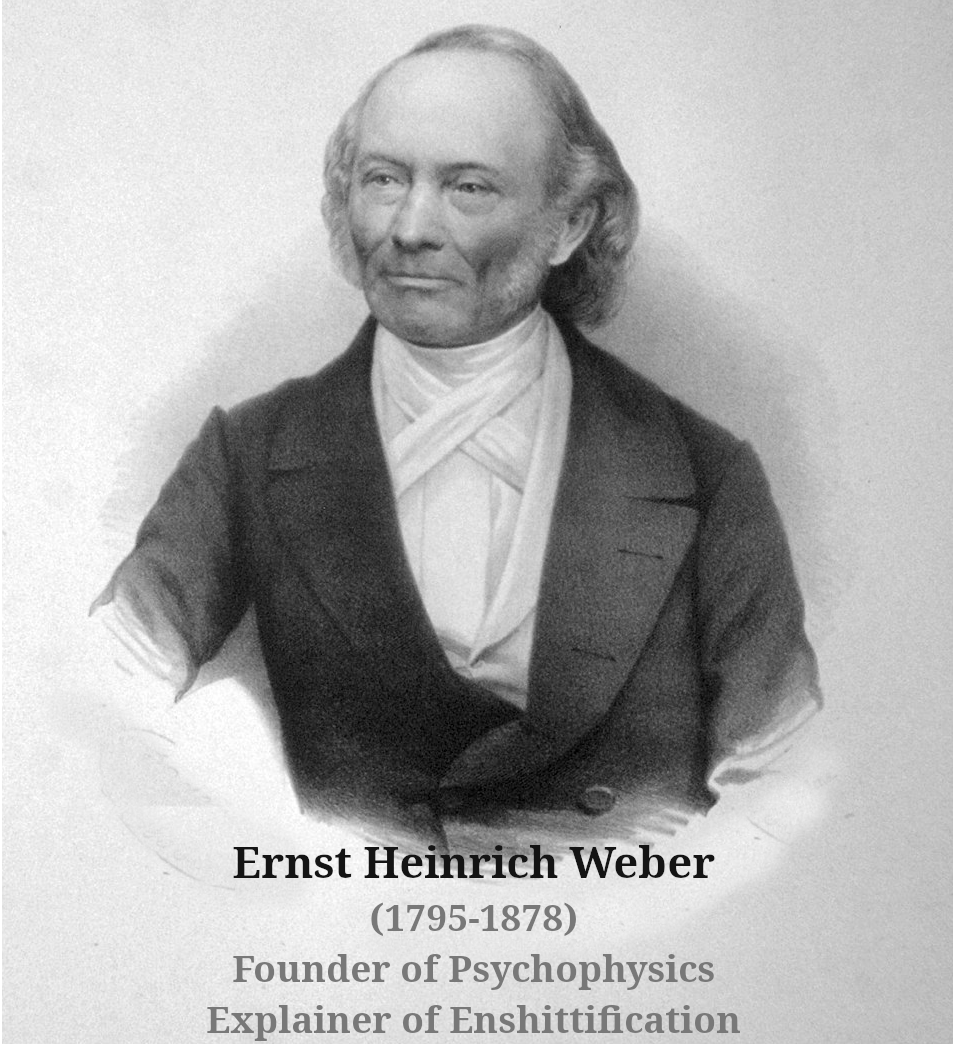
What a 19th-century German physiologist says about the decline of social media today
Back in 1834 at the University of Leipzig, Ernst Heinrich Weber had a question: how can we study human sensation like any other physical phenomenon? Until Weber, sensations were seen as too subjective to measure. Asking subjects “is this rock heavy” yields different responses based on a particular subject’s strength. Weber’s insight was to study how humans differentiate—is A heavier than B, or is C brighter than D? That was measurable.
Weber discovered that the smallest detectable difference between two sensations was not a fixed amount, but depended on the baseline comparison itself. Selecting the heavier between one- and two-ounce weights was easy, but choosing between 10 lbs. 1 oz. and 10 lbs. 2 oz. was not. The greater the stimulus, the greater the difference needed before a subject can tell the difference. That 19th-century observation now shapes how digital platforms, consumer products, and even political institutions change without provoking resistance.
Weber’s Law:
Here is how Weber’s idea works in plain terms. I is the starting level of some sensation—a weight you are lifting or a light you are seeing. ΔI (Delta I) is the smallest change you can actually notice. And k is a ratio for how sensitive we are in that situation. Sight, smell, and touch all have different abilities to discriminate—each sense has a different k value.
From Weber’s finding, we can express his formula to see the relationship relevant to this discussion as
ΔI = k ⋅ I
You do not need to follow the math to grasp the point: what matters is that perception tracks relative change, not absolute loss.
Now ΔI is the just-noticeable difference (JND) from the starting point of I and the sensitivity k. In practical terms, with human sensitivity to weight change at 10 percent, after holding a 1 kg weight, the smallest change a person can reliably sense is 100 grams. As the baseline increases, the detectable change increases proportionally: 2 kg – 200 g, 5 kg – 500 g, and so on.
Humans do not notice absolute changes; we notice proportional ones. A tiny increase is obvious when the baseline is small, but the same increase disappears when the baseline is large. As things get bigger, louder, brighter, or more familiar, it takes more change to register that anything has changed at all. That is Weber’s Law—and it is why gradual shifts so often pass unnoticed until adding up to something substantial. Think of the apocryphal boiling frog: changes can creep up outside awareness until it is too late.
Two Logos
Weber’s Law works in more ways than just what is heavier or brighter. Just look at the tale of two logos. Take Starbucks, which moved from its wood-cut, freaky-looking, maritime logo in the 1970s to the streamlined no-name logo of today over decades. Each change from 1987 onward was small enough that when the final current logo was revealed in 2011, no one noticed much of a change.
Compare this to Cracker Barrel in 2025. One big leap—even though it was a move back toward its original logo—produced too much change at once. People saw it right away and complained. If Cracker Barrel had just changed incrementally over decades, like Starbucks, few would have even noticed any difference.
Weber’s Law applies not merely to specific sensations of weight or light, but to a gestalt—the grouping of sensations that form an experience. Later work building on Weber’s Law by Gustav Fechner formalized this implication, showing how successive changes can remain imperceptible, as long as each change is below its own JND.
The Formula for Enshittification (ΔI<k⋅I)
Cory Doctorow coined the now widely accepted term enshittification as a blunt but precise way to describe how big digital platforms tend to rot over time. Social media platforms do not just “get worse”; they do so in a predictable sequence: first they are great to users to grow fast, then they favor advertisers or business customers, and eventually they squeeze everyone once people are locked in and alternatives are hard to reach. For Doctorow, enshittification is what happens when platforms face weak competition, strong network effects, and no real pressure to stop extracting more than they give back.
The key move is gradualism—small changes to feeds, prices, friction, or visibility that each feel annoying but tolerable, even rationalized as “normal.” Taken together, these cumulative platform changes steadily drain value from the user experience just beneath users’ ability to sense change. The process is not about what a feed or interface looks like on a given day; it is about gradual product and incentive shifts away from benefiting unaware users and towards rewarding investors.
Speaking of enshittification, Progressive Conjecture will be changing platforms
in the coming new year. More on this soon.
And we descend from user heaven to enshittification hell on the elevator of Weber’s Law. The operative question for any profit-seeking platform becomes: what is the maximum change that does not exceed an audience’s threshold to perceive change? Starbucks or Cracker Barrel? Given how extensively these firms already A/B test for engagement, it stands to reason they also map out thresholds of tolerable friction. Through such testing, a company could identify the k value—the threshold of noticeability for their user base—without committing to any platform-wide change. Then they can roll out revenue-enhancing degradations that stay just under the thresholds as first described by Weber nearly 200 years ago.
This logic is hardly new to business. Capitalists over generations have understood that imperceptible changes compound into transformations customers would never have accepted all at once. Every Oreo package that weighs a little less, every streaming service that quietly adds another ad break, every airline that shaves another inch of legroom—these all exploit the same perceptual limitation Weber first described.
The Importance of History
Human beings cannot rely on our current impressions of the world as presenting “what has always been.” We are simply terrible at tracking the small changes that move us from one decade to the next. Authoritarian governments, for example, thrive on Weber’s Law because citizens lose track of the small changes over time that move an entire country into despotism.
Social media’s inevitable decline is a warning to us all. Many things in our society are vulnerable to this problem—from consumer products to U.S. politics. Understanding history is therefore of utmost importance—while unable to predict the future, it is immune to Weber’s Law. History can tell us what we have lost, when we lost it, and how it was taken.
As labor historian Barbara Sparks said (in a line later popularized by Utah Phillips), “The long memory is the most radical idea in America.” And only a long memory lets us recover the baselines against which change becomes perceptible at all. Without it, we lose awareness of what good in society has been taken from us.
We know America, in the not-too-distant past, had a much more equitable distribution of wealth and only a handful of billionaires. We had a more progressive tax system that reined in the tyranny of excess wealth. But since Richard Nixon, decade after decade, president by president, we have lost sight of what really grew the American economy—spreading wealth across society. Income equity itself has been enshittified to make our economy benefit an oligarchy.
Social media is just the latest example of our lives falling prey to the social consequences of Weber’s Law. Without understanding our history, we will never sense what we have lost, and the path forward to a more just society will be that much harder to perceive.
Progressive Conjecture is reader-supported. If this essay was valuable, you can support the work here.
No obligation — for readers who want to support independent writing.
See where I first heard about Weber’s Law—a breezy but informative video from Numberphile.



Comments ()