
Ten Test Cases for Thinking About Social Change
How history shapes social problems—and how it can help us understand them

Recent progressive political failures stem from a poor understanding of history and a lack of imagination about how change could actually happen. As I look ahead, certain questions seem worth pursuing—not because they are fashionable, but because they expose persistent obstacles to social change.
What follows is a set of problems—test cases—worth thinking through carefully to examine how social change may actually succeed or fail.
I. Technology, Markets, and Unintended Consequences
Legalizing casino gambling does not increase anyone’s revenue
This is a simple question that requires more sophisticated research. It is farcical to claim gambling brings in revenue that could not be earned other ways. There is only so much disposable income in a casino’s catchment area.
People spending money at casinos are not going to the movies, for instance. There should be relatively simple ways to show that gambling revenue is rearranged rather than newly generated. And if more money is coming in, then we likely have a gambling problem and are paying far more in social services than before.
Ultrasound was horrible for women’s rights
As my aunt told me, when all the moms were pregnant with cousins in the 1960s, every pregnancy was a black box. No one without an embryology textbook had a clue about fetal development. Public discussion of abortion lacked a clear focus.
By 1980, about one-third of mothers had a pregnancy ultrasound, and the practice was well on its way to becoming routine. In 1985 we get The Silent Scream, a film that used ultrasound imagery to purposefully build a false narrative about a fetus—at the same time routine ultrasound was spreading.
Now ultrasounds go up on the refrigerator as baby pictures and fetal cardiac stem cells yield “heartbeats.”
Participation trophies build a better world
You’ve likely seen polls showing that around 51% of people aged 18–39 want to see a democratic socialist as president. How did we get here? Participation trophies.
A basketball phenom relies on all the non-phenoms on the court to look good. For a long time in America, only the best players and winning teams were honored. Now we’ve finally acknowledged the kids who make the games—and stars—possible.
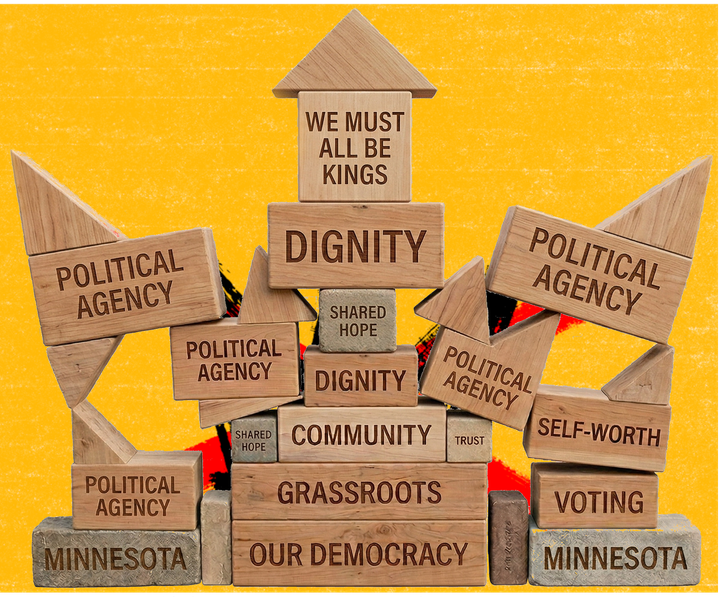
These are the kids who show up even if they aren’t great players and their teams aren’t very good. Their contribution matters, because without them, nothing happens. Expand this logic to politics, and you get voters who know they have worth. They want health insurance, vacations, and parental leave because their sense of self-worth wasn’t ground down in the same way.
II. Institutions Built for Another Era
Biden as the last 20th-century president
Even though he was elected in 2020, Biden carried 20th-century DNA into office. His political skills served him well, and the Democratic coup was unconscionable and reckless. However, Biden believed Trump was a bug, not a feature. He was stoic and did not detail the level of mismanagement and damage he inherited. The administration feared looking vindictive and political, so it hesitated on criminal investigations.
In foreign policy, there was a less-than-skeptical attitude toward Israel in Gaza, no doubt rooted in memories of pre-nuclear Israel. There was also timidity in Ukraine firmly grounded in Cold War concerns. Outside of tirelessly filling the federal bench, little was done to future-proof the government.
Just how democratic are we? It should be more than a few votes a decade
We are not very democratic as a society. There is no voting for workers in workplaces. No voting for students about schools. Membership organizations—rock clubs, garden clubs, Moose lodges—places that once had local democracy—are dying from lack of participation.
Union membership, while finally gaining again, is still down from the 1970s. Is democracy becoming more difficult and fractured because we lack the everyday local experience of debating issues, following Robert’s Rules of Order, and voting for club presidents? Are we shrinking democracy to the occasional ballot while ignoring broader participation?
Our Constitution was an economic union—and that’s our problem
This has been a progressive critique since Charles Beard in 1913. Maryland charging Virginia to use the Potomac did not sit well. So the monied class went to Philadelphia with their wish lists and wrote a Constitution that protected slavery and interstate commerce, while providing unprofitable but necessary services like an army and postal workers.
The project was to secure the states’ support. States selected presidential electors. States selected senators. Those officials appointed lifetime federal judges. The U.S. House was one-half of one-third of the government elected by the people—and even those districts were created by states.
Much of what we now load into and onto the Constitution does not fit its original intent, and the resulting tension is obvious and unavoidable.
Delaware corporation law must change to end Citizens United
With about 5% of the nation’s corporations and over two-thirds of the Fortune 500 calling Delaware home, the state has long been a hub for corporate activity. While Citizens United allowed corporations to spend funds on politics, it was silent on the fact that a state could simply bar its corporations from doing so.
How? Corporations are creatures of state law, not independent entities. For Delaware, there are now compelling arguments that political spending—especially non-candidate spending—runs counter to directors’ fiduciary duties. States could simply ban it. If you could get Delaware, you would lock down a substantial portion of U.S. business political spending.
III. Identity, Sovereignty, and Moral Conflict
Abortion and Stand Your Ground
“The risk of death attends the act of birth.” —G. Leopardi
A pregnant woman faces permanent disability and death. Our common-law roots do not require anyone to face harm or self-sacrifice without swearing an oath to do so. A firefighter is obligated to enter a burning building; bystanders are not.
Look at how common-law protection from harm is expanded in Stand Your Ground Laws, where there is no duty to retreat wherever you are before using violence to defend yourself. But if a state denies access to abortion, it is, in effect, compelling women to accept harm as members of a kind of procreation militia.
What if no one cared about gender?
I have touched on this topic before (“Why Passports Have Sex”), but for the sake of the thought experiment, imagine a society that truly did not care about gender, except where procreation requires sorting it out.
No one cared how you dressed, which bathroom you used, or which consensual partners you took. As a society, we are obsessed with what team someone is on. Try buying a blue shirt for a five-year-old boy without some piece of sporting equipment on it.
I also blame ultrasound for this. Capitalism now has six or so months to market gender-specific items to parents, versus back when they found out at birth. What would LGBTQ+ identity be in such a world, and what does that say about the world we inhabit now?
We were always fractured politically
A straightforward question that requires research. When pundits talk about the lack of civility in politics, their frame of reference is often World War II– and Cold War–era politics. When you are worried about the other side nuking you, you tend to keep the crazy uncles away from the family reunion.
The war effort and the Cold War enforced an orthodoxy of appearance. Remove that external pressure, and we return to older patterns of division. Even the gunfight at the O.K. Corral had a Democratic sheriff opposing Republican marshals. Aside from the recently established dearth of shame, we may be looking to the wrong past to evaluate current events.
If one of these test cases seems worth pursuing, I’ll take it up in depth.
Happy Boxing Day
Comments ()