
La Gringa and the Democratic Party's Future
Put voters first as voters before anything else
A pretty good off-year…
The off-year elections are going well for Democrats in state elections. New Jersey's governor and a sweep of state offices and the assembly in Virginia—these are solid wins, but not far from the usual electoral reaction against the President's party. And we had many special elections that flipped seats, also good, but special elections are—well, weird. Such campaigns are simple turnout pushes because most voters have no idea the election is happening. This favors a party out of the White House because these are the engaged voters, worried about getting back into office, who do pay attention. Overall, so far so good for Democrats. But, if we are honest, Democrats are as much relieved by not screwing up winnable elections as happy in flipping any new seats.
…and then Miami
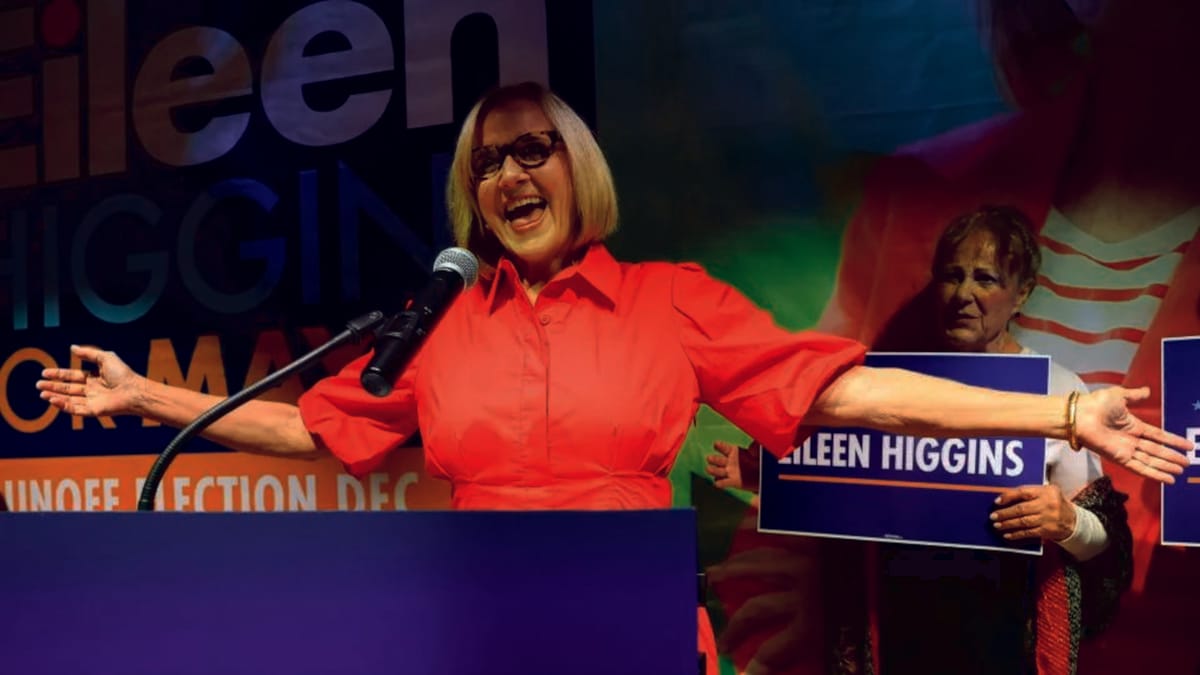
Here something different happened. Eileen Higgins wins the mayor's race in Miami: the first Democratic and non-Latino candidate since Steve Clark in 1993 (fun fact: Clark was the first non-Latino mayor since 1973). And, obviously, the first woman ever elected Miami's mayor. How did this happen?
Well, first she outspent the hell out of her opponent on television —19 to 1—thanks to national grassroots money. Republicans were caught napping, counting on Cuban support and a broader rightward shift among Latino voters, so they did not raise and spend enough. But money alone doesn't explain this; plenty of well-funded campaigns fall apart on Election Day. Even a solid Democratic ground game, by all reports excellent in Miami. Higgins had something else working for her—and Hedgehogs campaign offers a lesson every Democrat could benefit from if they would simply follow it.
La Gringa
"La Gringa" began as a half-joke from Spanish-speaking supporters, political opponents, and the local press during Higgins's first upset campaign in 2018, running for a Miami-Dade County Commission seat covering Little Havana and many other 70-plus-percent Hispanic precincts. Facing the well-known Cuban Republican Díaz de la Portilla–Barreiro machine. she deliberately leaned into being an obvious outsider—white, non-Latina, with a hard-to-place name—by taking the "La Gringa" nickname to heart. She campaigned in Spanish, used "La Gringa" in her own messaging, and then kept the brand as she won reelection on the commission and, eventually, the mayoralty—with national and local outlets now routinely describing her as proudly bearing this name in a 70-percent-Hispanic city. She made an identity-politics weakness into a strength with honesty and earnest effort to connect with voters first.
The Effective Strategy
La Gringa campaigned on the same themes as other progressive mayoral candidates, like New York's Mamdani: affordability, infrastructure, transit, and corruption. The lesson for Democrats is she had one campaign on these issues. She talked to everyone as voters first—voters who are Latino or Haitian—rather than running a "Latino campaign" or a "Haitian campaign." This is an important distinction. There is respect in first talking to people as city residents and then filling in with specific ethnic-based issues, versus trying to win votes based on ethnic appeals. She even talked about Miami police's ICE cooperation within the context of living together in a city. From her final campaign debate:
"We have from Washington and Tallahassee a culture of trickle-down hatred. The way they are talking about our residents . . . who are our neighbors, who live on the street with us, who go to church with us, who go to synagogue with us, they are speaking about people as if they are less than human."
A more traditional Democratic approach speaking against ICE cooperation would list ethnicities oppressed, as if checking boxes. Democrats see that as inclusive, but such language still draws an "us" and a "them" in political speech. Plus, no one wants to be seen first as oppressed, so voters reduced to checked boxes may be rightly put off. Higgins, instead, chose a unifying message. We are in this together. We are us.
Yes, she has fluent Spanish, and yes, she benefited from a majority Latino electorate coming to terms with an ICE that displays just how much Republicans truly hate them. This helped forge connections certainly. But Higgins still could have lost had she not insisted on treating voters as voters first. Her message was consistent and honest, and that clarity carried her.
Democrats must learn this simple lesson. While injustice—distributed unevenly across ethnicity, gender, and class—must be acknowledged and overcome, such categories must never define our expectations for any voter. We must first see every voter as an equal partner in the pursuit of happiness, and not as any victim of oppression. After that, we fight injustice together, because an injury to one of us is an injury to all.
This is the answer for Democrats to Trump, MAGA and America First—Voters First.


Comments ()