
The Left, Right, Up, Down, In, Out of Politics
Why can't AI fix a 1993 Ford Ranger? The same reason progressives keep misreading the electorate — both fixate on one tidy explanation and ignore the messy permutations. Pew's new political typology points to a more useful picture, and some unexpected common ground.

For anyone worried about AI taking over the world, try using it to solve why your 1993 Ford Ranger refuses to start. Ask an AI for a truck's production history and that works fine. Ask for a picture of an in situ fuel pressure regulator and how to change it and, well, there are problems.
AI gets confused — a single Ford Ranger in 1993 could be ordered with: five trims (XL, XL Sport, XLT, STX, the Splash), three engines (2.3 four, 3.0 V6, 4.0 OHV V6), manual or automatic transmission, two or four wheel drive, two cab styles, two bed lengths, two box widths, plus packages from Touch Drive 4×4 to the 3.73 limited-slip 4×4 — and any of the approximately 150 permutations may or may not be relevant to whatever needs work on the truck. And once an AI gets an idea in its virtual head, it keeps going back to that in-tank fuel pump assembly that has nothing to do with your problem and goes down an increasingly obscure, hallucinatory road.
This whole repair exercise reminds me of progressives' understanding of politics. We, writ large, tend to reduce problems to the more conveniently collected information and perseverate on an explanation without considering the nuances within the electorate where coalitions may be found. When people vote against their interests we blame the victim. So white rural voters support MAGA because of stupidity and racism, not stopping to consider that only a few decades ago, the stark partisan difference between rural and urban was nearly non-existent and that something must have changed in recent memory. This hanging on to a notion that is challenged by evidence keeps us from seeing a more useful picture.
Not My Type, but...
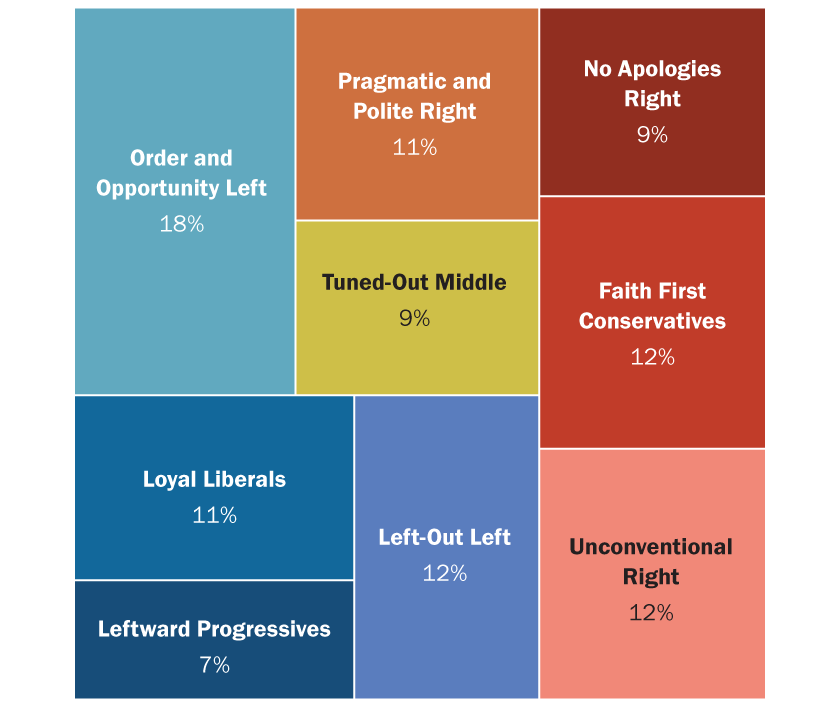
The Pew Research Center has done another iteration of its political typology. After interviewing over 10,000 people and clustering the responses, Pew created a nine-category schema to illustrate where voters are. These are permutations on a few dimensions in a voter psyche — how much do you trust government, political parties, other people, and collective action. But, as with my truck, politics can get complicated with just a few options.
While the findings are not shocking, it is an excellent description of how people organize their political thinking from Right to Left. The report is worth reading; I cannot improve on it. The results show more blue voters than red. The hard-core MAGA in the upper right corner is at 21% — which hovers around the same percent of the population found to be Authoritarian Personalities, the only statistically significant variable that predicted Republican votes in the 2016 primaries (votes for Trump, naturally). Outside of this fascist segment, there is common ground with the other red square conservative groups on the chart, which are where some may say the old "establishment Republicans" live. A very worrisome grouping is the Tuned Out 9%. Across race and class, these voters willfully ignore politics and if they do decide to turn out, not knowing the issues, the stakes, or even much about how government works, they will Dunning-Kruger an election into the ditch — then forget how it happened.
This Pew report is another frame for my politics inspired by car revival. To turn back MAGA, progressives will need to shed prejudices and righteousness to talk with people who are not always politically correct. We must focus first on what we all can agree on — stop the bleeding — and then get to a government that actually can govern so we can argue about other things later. What progressives can take from this typology is there exists points of agreement across groups which on the surface are opposed. The common ground is in this report. Consider politics as a journey, not a final destination, and we can work with people who are traveling in our direction, even if we are not all at the same mile marker.
Truck update
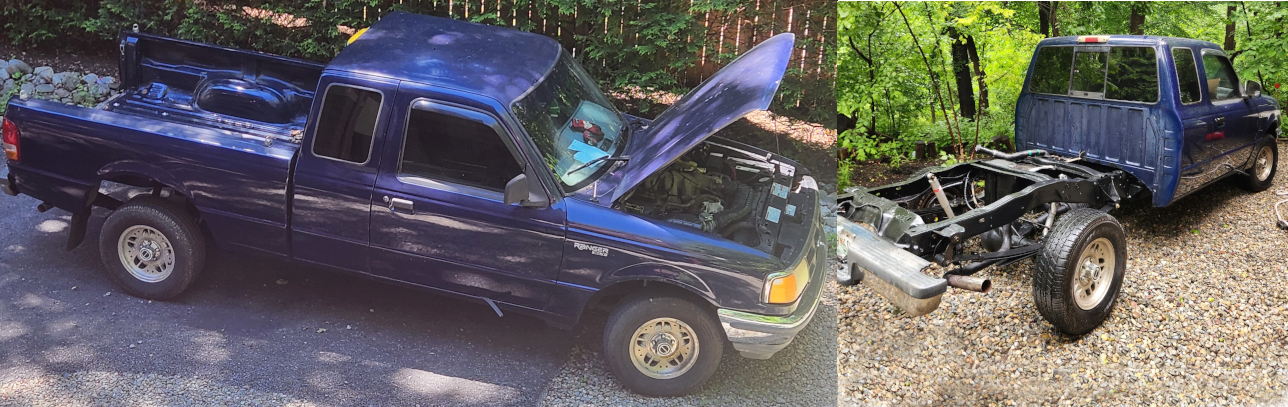
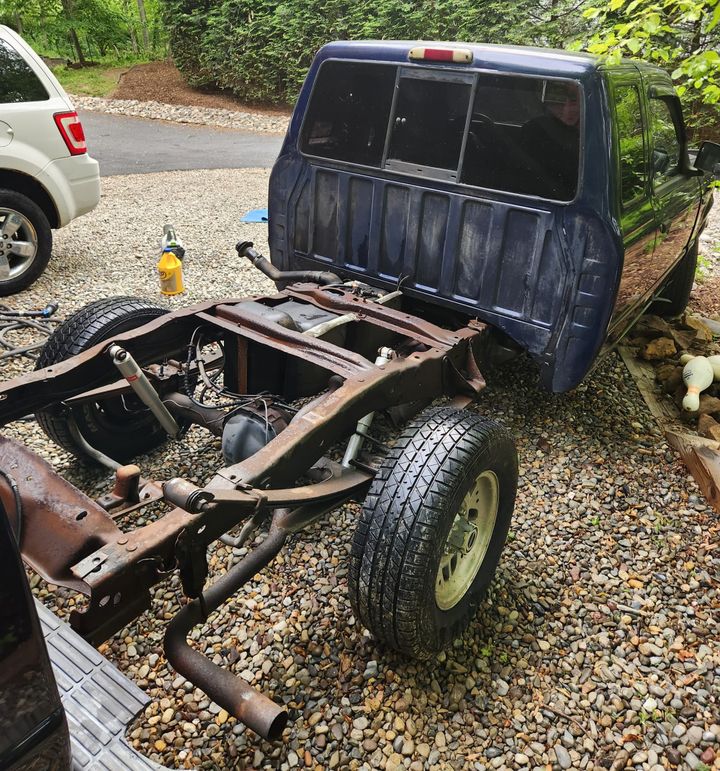
For those readers who remember from last time. My truck has its bed re-attached and even happily ran for a day afterwards. The fuel line leak is finally fixed, after my epic fail of replacing the wrong side. I had no idea the return line to the tank could leak so much, so I assumed a supply line problem and replaced a perfectly working hose. Fortunately, I had enough left over to make the needed repair. There is a lesson in this, surely.
Another lesson is, perhaps, leave what works well enough alone. I set out to clear old computer trouble codes by disconnecting the battery overnight. Not a necessary thing, just curiosity. Next day, no start, I have spark and fuel — maybe too much fuel — or not enough air. Hence the fruitless AI searches I opened today's newsletter with.
So if any readers are mechanically inclined with suggestions on how to proceed, please be old-fashioned and send me a message. AI has not bested us, yet.

Comments ()