
Why Passports have Sex
Challenge assumptions then change the world
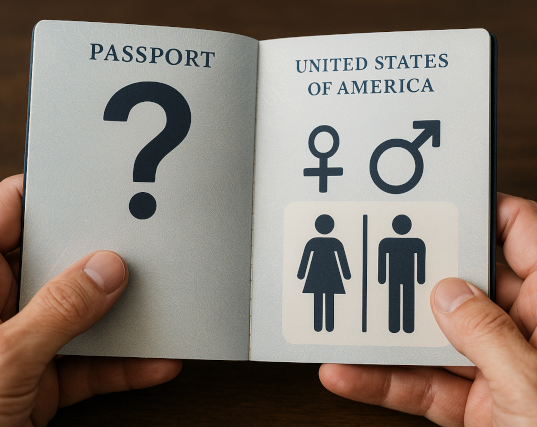
Why do we list sex at all on a passport? Obscure treaty obligations aside, what’s the benefit? Before photos and biometric data, sex helped confirm identity along with height or hair color. But are we still listing sex simply out of habit—one born more than a century ago?
“Habit is the flywheel of society,” said William James in his Principles of Psychology at the last century’s turn. For those less mechanical, a flywheel is a heavy wheel within an engine that is hard to get spinning but, once moving, keeps an engine’s power steady. Habit does the same for society—a set of routines we learn once, then repeat without thought. If, one day, everyone had to relearn how to bank, drive, or even when to say “good morning,” society would collapse.
Bad Habits
Social habit is necessary but also enforces oppression with a flywheel’s constancy. Consider Jim Crow. Southerners did not everyday carry an apartheid rule book on oppression; rather, they had expectations, received from their mothers and fathers, of Black folks’ place, and vice versa—this was the foundation for Jim Crow injustice.
Bias breeds bias
Progressives must see how habit holds onto our racism, sexism, classism, and every bias that oppresses someone else. People just hold onto habits and assumptions that feel so fundamental no one questions them. But questioning assumptions is critical for ending injustices.
Let us take a simple, not life-or-death, example—why do girls play softball? If there is a sport where boys and girls or men and women could play on equal footing, it is baseball. Just look at player sizes from shortstops to outfielders and that most of the game is either standing in a field or sitting on a bench. It could work.
In the mid-20th century, there was a bias toward girls’ softball, “…because of the smaller dimensions of softball, as opposed to baseball, and the softer projectile as implied by the game’s moniker, the pastime earned a reputation as gentle enough for women.” But this worldview was cemented by Little League Baseball Inc. (LLB) in the 1970s. After courts mandated girls onto teams, LLB hatched a plan to divert girls into their own league—softball—with its own Little League. LLB leveraged still prevalent biases among parents and schools toward softball to keep girls out of Little League baseball. So today, while accomplished women athletes play fastpitch softball, you have no women making millions in Major League Baseball because nearly all were shunted from the pipeline young.
Habits change
Thirty years ago, gay marriage was preposterous to most people. Beyond prejudice, there was a more basic “I cannot make sense of this picture” problem that social habit presented—all while few realized how new this picture of “marriage” really was, widespread among the non-affluent only since the turn of the 20th century.
While LGBTQ+ acceptance grew over this time, I believe the understanding of marriage changed as well. Married people recognized being married makes you next of kin for rights in the worst of times, provides a legal framework for family life, and even makes pensions and Social Security more equitable. These insights emerged only through hearing stories from those denied marriage, and then empathy began to overtake habit.
Sex on ID
The SCOTUS majority opinion called sex “a matter of historic fact.” But why does history need to be on our passports? What purpose does it serve? My address, country of origin, this is useful. How does sex stop smuggling? This extends to the driver’s license. A driver’s sex has no relevance to speed limits. Government photo ID has no reason to include the holder’s sex. We could even consider leaving it off birth certificates as well, with some minor changes in data collection.
There are important public health and policy reasons to collect data on gender or ethnicity. But that could be divorced from our public identifications entirely. The Social Security Administration knows account holders’ genders for actuarial reasons and historic record, yet sex doesn’t appear on Social Security cards. What does it say that our most important federal ID doesn’t need sex—but passports and driver’s licenses do?
A thought experiment
This is no alarm call to change our IDs, only a post on how we could—easily—and are only limited by habit. But, beyond fairness to LGBTQ+ travelers and drivers spared the Trumpian prejudices on sex, there may well be a benefit for everyone.
Remember people laughing at changing “Fireman’ to “Firefighter” or “Policeman” to “Police Officer”? Those changes took hold and played a significant part in opening opportunities to women by making the titles about the job, not the employee’s sex. Think about what having sex on a passport or drivers license says. We have male drivers and female drivers—not drivers. We have female travelers and male travelers—not travelers. This habit reinforces inequality by recognizing an arbitrary division for equal roles.
Consider how our society would change if these habitual references to sex were gone. The Supreme Court majority in Trump v. Orr, which upheld restrictions on gender markers, delights in its own vindictiveness and will not change. But what if we simply did not give places for hate like theirs to land? Your habits might say we need to see sex on an ID. But do we really? An ID listing sex with no need to do so turns something harmless into an instrument of exclusion. For me, being progressive means—how can government be its best while doing no harm along the way. The best policy for all may be, surprisingly, to give up on sex.
Comments ()