
Voters don't know
Most people do not understand their support of Trump
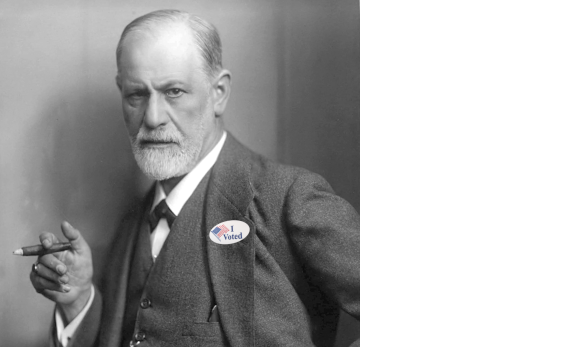
In college, I had an opportunity to attend an extension class at the Cleveland Psychoanalytic Institute to learn about psychoanalysis from a practicing analyst. After a time, I raised the usual critique of Freud’s work as just a product of wealthy Vienna society, not so applicable elsewhere. His response stuck with me for 30 years—”Well, everyone needs to learn where to poop.”
Childhood and memories
The core contribution of Freud and psychoanalysis useful for understanding politics is two-fold. First is that how a child is introduced to society matters. Growing up means understanding your self as you settle into society’s rules and expectation—from poop onward. Are you strictly or permissively parented? Is your upbringing nurturing or withholding? Are you introduced to the power structure from a position of privilege, or not? Adulthood is shaped by this childhood initiation.
The second is we cannot easily speak about why we feel and act the ways we do. The unconscious versus conscious is distracting wording for this piece, loaded with distraction, so let me simplify—We feel and act before we think. Our memories judge the world, but not every memory is available to us as a file on the C: drive. Conscious thought and speech are only the cream rising from the dairy below. Much is written about how and why remembering or not remembering happens, but the focus here is that talking about why we do most anything important in our lives is really us finding a story to tell ourselves to explain how we act or feel versus rational consideration of facts or perfect memory. And for such matters, it often requires work over time for these stories and our lived reality to align.
Unconscious voting
So, to grossly oversimplify for an example, consider a hypothetical therapy client who, say, wants a committed relationship but always fails in them. Therapy sessions over years work backwards to discern why they act in certain situations in particular ways that are not best for maintaining relationships. If successful, this introspection connects past to present and they work through why relationships are difficult to then find new ways forward. This is a very deliberate and intentional process to understand and act.
With this in mind, consider voters and voting.
Take the park ranger who said she voted Trump for the free IVF—is that really why? Is she so unable to engage politically that this is the best she could say? Or is it how she reconciled her discomfort with Harris as a black woman without sounding racist? Setting aside the obvious vocal doctrinal racists, racism’s insidiousness is it happens before conscious thought. A person may be raised to not be explicit about race, but still carry the bias. So explaining the discomfort with one candidate versus another is reconciled with an acceptable story versus understanding choices as the analysand had done above. What many voters say is not truly connected to why they act. So working from what they assert to change minds is not effective because new rationales can slot in for the old as the true reasons are still concealed.
Progressives, even those raised by fellow travelers, have spent many hours talking and thinking about politics. Set outside the dominant ideology, progressive thought is discovered by considering politics intently at one point in life, at least. While most progressives are not walking theory textbooks, resisting what the privileged and powerful say is truth requires study and introspection. Not unlike therapy.
So progressives must persuade those who have not considered their politics intently and act on how situations feel over any logic. But. too often. we just do not see this problem, it being so far from our own experience. The Right, however, gets it. They do not argue policies, just find ways to evoke feelings. So, for Trump, so many people have so many “reasons” to explain their support. But it all reduces to evoking feelings through vague notions of what Trump will do. Democrats like Franklin Roosevelt could appeal to feelings for a good cause, but it is a skill in short supply among progressives, who do not understand the necessity or even find such appeals unethical.
Bringing up fascists
But the MAGA core has a particular twist in their worldview—these are authoritarian personalities. Described by Theodore Adorno in 1950, he put forward how a strict, punitive parenting style that suppresses a child's natural impulses may create internal conflicts that are resolved as authoritarianism in adulthood.
Adorno measured specific personal traits to create an f-scale—as in “f” stands for fascist. Authoritarian personalities have a:
- Strong adherence to conventional norms and values
- Unquestioning submission to authority figures
- Aggression toward those who defy established norms
- Resistance to introspection and subjective experiences
- Rigid, stereotyped thinking patterns
- Preoccupation with power dynamics and toughness
- Cynicism and destructiveness
- Projection of personal conflicts onto others
- Exaggerated concerns with sexuality
Sound familiar?
It was all there in 2016
Matthew MacWilliams describing his 2016 research into the South Carolina GOP primary:
In the five days leading up to the South Carolina Republican primary I fielded a survey of 358 likely voters, hoping to better understand who supports Donald Trump, why, and what it may mean for the Republican presidential nominating contest.
What I found is a trend that has been widely overlooked. A voter’s gender, education, age, ideology, party identification, income, and race simply had no statistical bearing on whether someone supported Trump. Neither, despite predictions to the contrary, did evangelicalism.
Here is what did: authoritarianism, by which I mean Americans’ inclination to authoritarian behavior . . .
. . . Authoritarianism and a hybrid variable that links authoritarianism with a personal fear of terrorism were the only two variables that predicted, with statistical significance, support for Trump.
Political scientists use a few survey questions about desirable qualities in children, known as the Child-Rearing Preferences Scale, to study authoritarianism. Not a perfect scale across cultures, but its advantage is how not political the questions are, evoking more honest answers. Respondents are asked to choose which is more important for a child to have. These sets typically are:
- Independence or Respect for elders
- Obedience or Self-reliance
- Curiosity or Good manners
- Being considerate or Being well-behaved
MacWilliams found these questions establishing authoritarianism and one concerning a fear of terrorism were the only ones in the entire survey that predicted Trump support at statistical significance. The fear was connected to authoritarianism, because the greater the fear, the more likely a voter would swing towards authoritarian. And, just how logical is any concern for terrorism in South Carolina? Or is it a feeling?
I have seen studies that place authoritarianism rates in the U.S. anywhere from 18% to 40% of the population. A horrible number on either side for that part of MAGA raised from childhood to follow strongmen. Combine this with the vast number of unaware voters easily moved by fear, and the enormity of our MAGA problem is clear. What is also clear is progressives cannot talk the country away from MAGA with logic and policy or even believe much of what voters tell us their motivations actually are. We need a different approach.
Have faith
One very interesting point came from MacWilliams’ 2016 research.
I did find one soft spot in Trump’s support. Regular, weekly church attendance — as measured by a standard Pew Research question included in my survey — predicted a statistically significant and substantive opposition to Trump.
Surprising, considering evangelical support for Trump, however, not all church-goers are christian nationalists. Most progressives, though, would see all southern churchgoers as a lost cause. This is just one example of why challenging assumptions leads to more useful strategies. If we study the problem and work past appearances, we may have more allies and better strategies than our current lack of introspection allows us to see. Progressives have work to do as well.

Comments ()