
Unlawful Orders in Trump's DC Military Occupation
Soldiers know not to follow, but could use tools to resist them
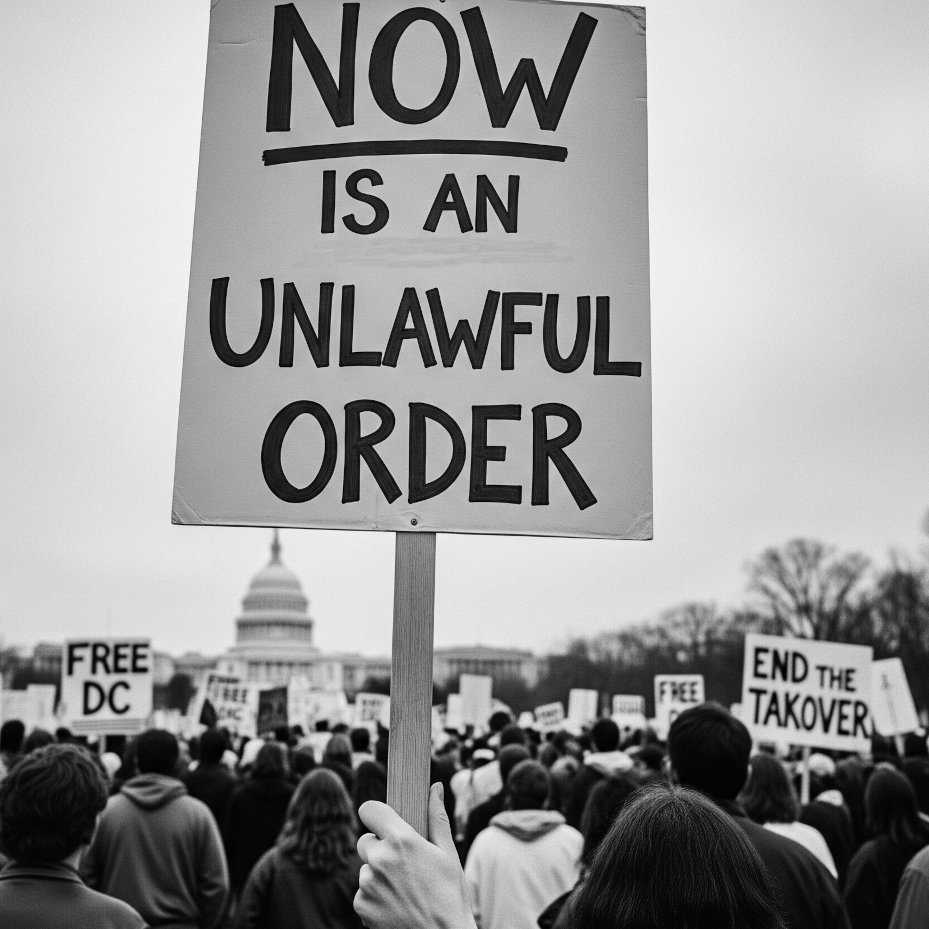
With Trump’s expanding military occupation of the District of Columbia, the idea of unlawful orders—with troops armed and patrolling the city—is part of daily conversation.
Cognizant of the ethical dilemmas troops may face while deployed in this manner, the University of Massachusetts Amherst’s Human Security Lab surveyed 818 enlisted personnel in June. As reported by the Military Times, 80% said they understood their duty not to follow unlawful orders. Of the rest, 9% answered “don’t know,” 2% “no comment,” and 9% said they would “obey any order.”
What is an unlawful order
The Uniform Code of Military Justice assumes all orders are lawful except those found unlawful. From the Military Law Task Force:
The Rules for Court-Martial say that an order is lawful, “unless it is contrary to the Constitution, the laws of the United States, or lawful superior orders or for some other reason is beyond the authority of the official issuing it.” The Rules go on to say that, “This inference does not apply to a patently illegal order, such as one that directs the commission of a crime.” Finally, the Rules say, “The lawfulness of an order is a question of law to be determined by the military judge.” That determination normally can be made only after a service member refuses or obeys an order, in a court martial or a war crimes tribunal.
This definition is as fuzzy as Justice Potter Stewart’s description of obscenity: “I know it when I see it.” To fulfill their duty not to follow an unlawful order in the District today, soldiers must weigh the Constitution, federal law, international war and human rights law, and even domestic criminal law—all under the threat of court-martial, where they must prove under this vague standard that the order was illegal. Imagine whistleblowing, but with tanks, guns, prisons and deaths.
Typically, soldiers are not deployed on missions requiring expansive legal knowledge. Trump has now placed troops in a situation where their training and experience leave them all ill-equipped for success. Add the vagueness of “unlawful order,” and this deployment in a District protesting their very presence becomes much more unsettling.
Understanding
The Human Security Lab questionnaire asked an open-ended question: “Under what conditions would you find an order so obviously unlawful you would be forced to disobey?” Here is a tag cloud covering their responses.
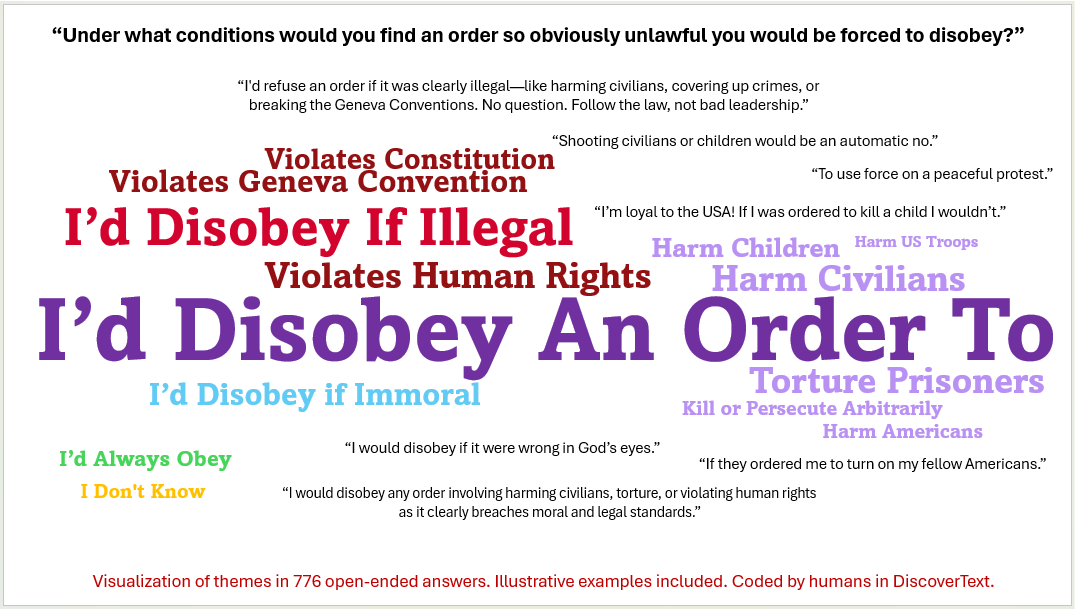
For the most part, encouraging—except that bit at the lower left. While soldiers offered a range of responses and thresholds for not obeying, it is good that so many clearly state that some day, for some reason, they must refuse to obey an order.
However
This question came up in the survey:
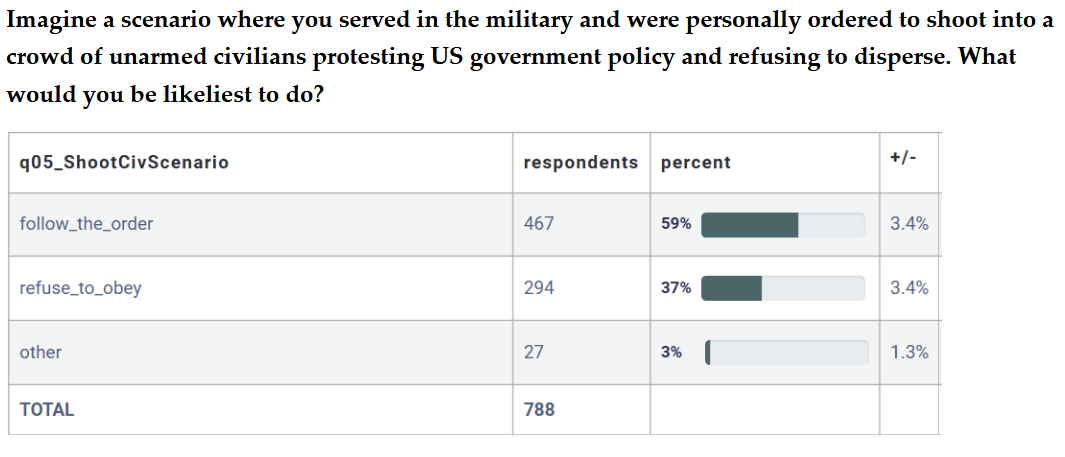
The nearly two-thirds citing “shooting unarmed civilians” does not align with the earlier 80%. What could be a clearer illegal order? Shooting civilians is a war crime and a human rights violation on its face, even before domestic law. How can both views exist in the same universe?
Generally, it is good that soldiers follow orders. Armies cannot maneuver if every action requires debate. Obedience is built through training, esprit de corps, and discipline. For soldiers, the reasons to follow orders are many and familiar; the situations demanding refusal, conversely rare.
Responses to Q5 were likely fatalistic. Soldiers were not saying they would happily shoot civilians. Many likely recognized that pressures from training and peers, compressed into a moment of decision, would push them toward compliance with such an order.
Tools to resist
The Lab’s research shows that conversations about unlawful orders change how soldiers consider their actions. These discussions support a soldier’s sense of agency regarding their orders and move them, as a group, toward that 80% noncompliance with illegal ones. For this unusual and more legally complicated deployment in the District, a soldier must be particularly aware of this possibility. Outreach will reshape how soldiers consider their conduct while patrolling city streets. The question is, how can this be done?
A outreach campaign across media, focused on deployed soldiers, with simple messages on the duty not to follow an unlawful order, would make District residents safer. Giving soldiers clear, supported ground to resist illegal orders makes these outcomes more likely. Convince a few soldiers to take a stand and many more will follow suit—perhaps even marching away from a Trump-driven political tragedy in the District of Columbia.
I want to thank Professor Charli Carpenter, Political Science, UMass Amherst and Director, Human Security Lab for the thoughtful responses to my questions.
Comments ()