
Everyone a Sovereign: Fear and Self-Loathing on No Kings Day
Curmudgeon's take on No Kings Day: the protests are therapeutic. The real problem — a 45-year orchestrated attack on American political self-worth — is where we need to look.
Another No Kings Day is coming up, and we get a new set of packaged pop-up protests across the country. Then Monday, Rachel Maddow will be on MS NOW going through the list of how many people turned up in red districts to protest Trump. Energized picketers will remind anyone who listens that 3.5% of the population in sustained protest is the magic number that topples regimes like Trump's.
At the same time, curmudgeons like me say this Indivisible project is primarily a list-building exercise for mid-term Congressional campaign door-knocking, and that turning out a few thousand faculty and students from a red district's single college town is not a groundswell. And while volunteers are needed and No Kings may be good activist training, its protests are mostly therapeutic anxiety-reduction. They do little to stop the regime. And they do nothing about the deep social problem metastasizing since Ronald Reagan — the problem that drove Trump into office. Twice.
My criticisms of No Kings are not the events themselves, but how I see them falling short in reality versus the broader progressive imagination. This weekend's protests arrive against a much starker landscape after a year spent moving from waiting to witnessing his crimes. As Trump 2.0 unfolds, our understanding of the electorate must match the scale of the challenge. While I do appreciate Indivisble's local focus, periodic protests cannot move voters on their own and are only a first step to change. To understand why, we have to look at the political ground those voters now stand on.
Difficult Ground
Trump is sinking in the polls. The U.S. economy lost 92,000 jobs in February – the third monthly loss in five months – and Trump tariff-driven inflation expectations are now at 6.2%, their highest level since 2022. So no surprise only 29% approve his handling of the economy. And this is before his Iran War and the single largest oil supply disruption in world history: the closure of the Strait of Hormuz, sending crude past $100 a barrel and pushing the average U.S. gas price from $2.94 to nearly $4.00 a gallon.
Broader polling reflects the damage. A Reuters/Ipsos poll closing March 24 put him at 36% overall approval. Just 35% support the Iran strikes, against 61% disapproving. Even in the MAGA base, his strong-approve number has slid from 26% to 21%, driven by non-college white women and rural voters worried about the economy. Watching Trump sink in this way must feel like good news to protesters.
However, Americans opposing Trump also find the Democratic Party — especially Members of Congress — weak and ineffective. A Pew survey (October 2025) found 67% of Democrats are frustrated with their own party, with 30% outright angry. YouGov/Economist put congressional Democrats at 21% approval against 68% disapproval. Independents say a pox on both, disapproving of Trump by 41 points (YouGov, February 2026) and giving congressional Democrats a net favorability of -42 points. So no great love for Trump's opposition in our country.
And we have lost international political capital. The Ipsos 29-country tracker shows the share saying the U.S. will have a positive influence on world affairs dropped from 59% to 46% since Trump's re-election. China, for the first time, is rated ahead of the U.S. China — the oppressive one-party state committing genocide against the Uyghurs and forcing Tibetans to assimilate — now polls ahead of us. And this is pre-Iran war research.
But here is an unexpected fracture in our politics. Americans are pessimistic about – Americans. A Pew survey released March 5, 2026, covering 25 countries, found that the U.S. is the only country where more adults describe the morals and ethics of their fellow citizens as "bad" (53%) than "good" (47%).
To recap: Americans are souring on Trump, see Democrats as hopeless, and distrust each other's morality — all while our economy is tanking and the world sees us as going to hell in a handcart.
Happy No Kings Day.
They want to see a fair and just world — but have forgotten how to make one.
Surveying the Kingdom
While Trump own-goals his presidency every day, he is still doing damage we all will contend with for years to come. Trump opponents who are also angry with the Democratic Party's failure to fight misunderstand how resistance must happen and that efforts tied solely to winning the House in 2026 address symptoms, not causes.
Frustration with Democrats reflects a profound mismatch: people want social movement style challenges to Trump from elected officials who lack the skill set and temperament for such work. Without a majority in the House or Senate there is little the Democratic caucus can do to fight Trump. Indivisible, born of congressional staffers, understands this reality — so do join the door-knocking Indivisible will organize; it is important to have a majority somewhere. But those who oppose Trump and are angry with Democrats do not want incremental beltway solutions over several election cycles with the same partisan seesaw. They want to see a fair and just world — but have forgotten how to make one.
For decades, people thought if they could work enough, borrow enough, follow rules enough, they could reach what their parents had — back when we had unions, a manufacturing base, and the rich paid taxes. Now, the data since Ronald Reagan shows working and middle classes losing ground, but what I see today are more people unable to deny this decline. The Trump era lays bare the naked, exploitative power that makes 21st century capitalism possible. He makes clear to all that only billionaires matter, and the rest of us are to be fought against or used until no longer useful. As president, Trump acts like a capitalist taking over a company. Presidential power is used to exert control and extract personal gain—because in this billionaire worldview, power is not meant to serve, but to enrich its wielder.
"If you can convince the lowest white man he's better than the best colored man, he won't notice you're picking his pocket." - Lyndon Johnson . . . The question this raises is: why does anyone feel low, and who is doing the convincing?
We are witnessing a revival of Social Darwinism and a new Gilded Age. This is a social problem far greater than who controls Congress or the White House. The challenge in the United States is not Trump alone, nor even billionaires individually. It is our society in which honest work is denigrated and accumulating a billion dollars in wealth is never challenged, but accepted as inevitable and acquiesced to as power.
Fear and Self-Loathing
Everyone in the United States is responsible for Donald Trump. The catastrophe we are living through cannot be the work of one man — particularly one this impaired. Instead, it is the capstone of a decades-long orchestrated attack on our political culture that produced our billionaire collaborator Quisling government. So, until we reckon with this culture, we will keep producing Trump governments — the next one perhaps more competent than the last.
Racism, sexism, all manner of prejudices in our history and society matter in daily life. However, the divide between rural and urban voters, for instance, that we now see as racist gospel is a recent phenomenon. Prior to the 1990s, there was little difference in partisanship between rural and urban. There has been a concerted assault on our political culture, to make progressive coalitions near-impossible to hold, and this thoroughly played out in rural America. Consider what Lyndon Johnson said to Bill Moyers. "If you can convince the lowest white man he's better than the best colored man, he won't notice you're picking his pocket. Hell, give him somebody to look down on, and he'll empty his pockets for you." The question this raises is: why does anyone feel low, and who is doing the convincing?
What has changed is that for decades voters have been caught in a pincer move against their own self-worth and agency. From Ronald Reagan onward, the privileged rebuilt the old barriers to economic security, generating constant anxiety, while simultaneously promoting a culture that denigrates government and measures a person's worth by affluence alone.
In administrations from Franklin Roosevelt to Jimmy Carter, voters saw governments that provided tangible goods and an ever-expanding list of rights and opportunities. College was cheap. Workers earned a more fair share. Voting became protected. Women gained rights. Support for Democrats rose from governments seen as benefiting more than just the rich. Voting mattered because government since the New Deal did something.
Ronald Reagan began dismantling the New Deal. Unions were overthrown. College degrees required massive personal debt. Pensions degraded into 401(k)s. Millions of once comfortable workers were thrown onto food stamps. Having a job became more survival than making a living. Government became a problem, not a solution. The unprivileged and poor were so from their own faults and failings, not because the system was rigged against them. This assault extended well beyond politics. Constant anxiety over providing a family with health care, a decent home, or even food is a broadside against agency and self-worth across a person's entire life — not just in front of a ballot box.
What has changed is that for decades voters have been caught in a pincer move against their own self-worth and agency.
Decade after decade, the privileged chipped away at national self-worth as the generation that remembered the New Deal faded from the electorate. The baby boomers took inherited success for granted, and each generation since has been told that falling short of it is their own failure. We became a people who remember only what was lost, having forgotten anything won together, and never seeing government succeed because it never stood a chance. This became a self-fulfilling prophecy — a government never given the chance to succeed confirmed what people had been told to believe.
Our politics became so fractured that the last president who served a full term with a House and Senate party majority was Jimmy Carter. Since then, Democratic presidents have only had two years to do anything constructive — after fixing Republican deficits. Delivering continuing meaningful change in this environment is impossible. There was a brief flicker of hopeful change with Obama, but even with the Affordable Care Act passing, his congressional majority was crushed in 2010 by a political culture with voters conditioned to believe government cannot work and that the ACA must be some trick.
Trump was elected twice, not from anger towards others, but from a self-loathing built from loss and powerlessness. We lost the memory of an effective government able to advance the common good. Voting was not a meaningful decision about a government — which now, by definition, always fails — but more like buying a lottery ticket or making a statement on what you thought of the country.
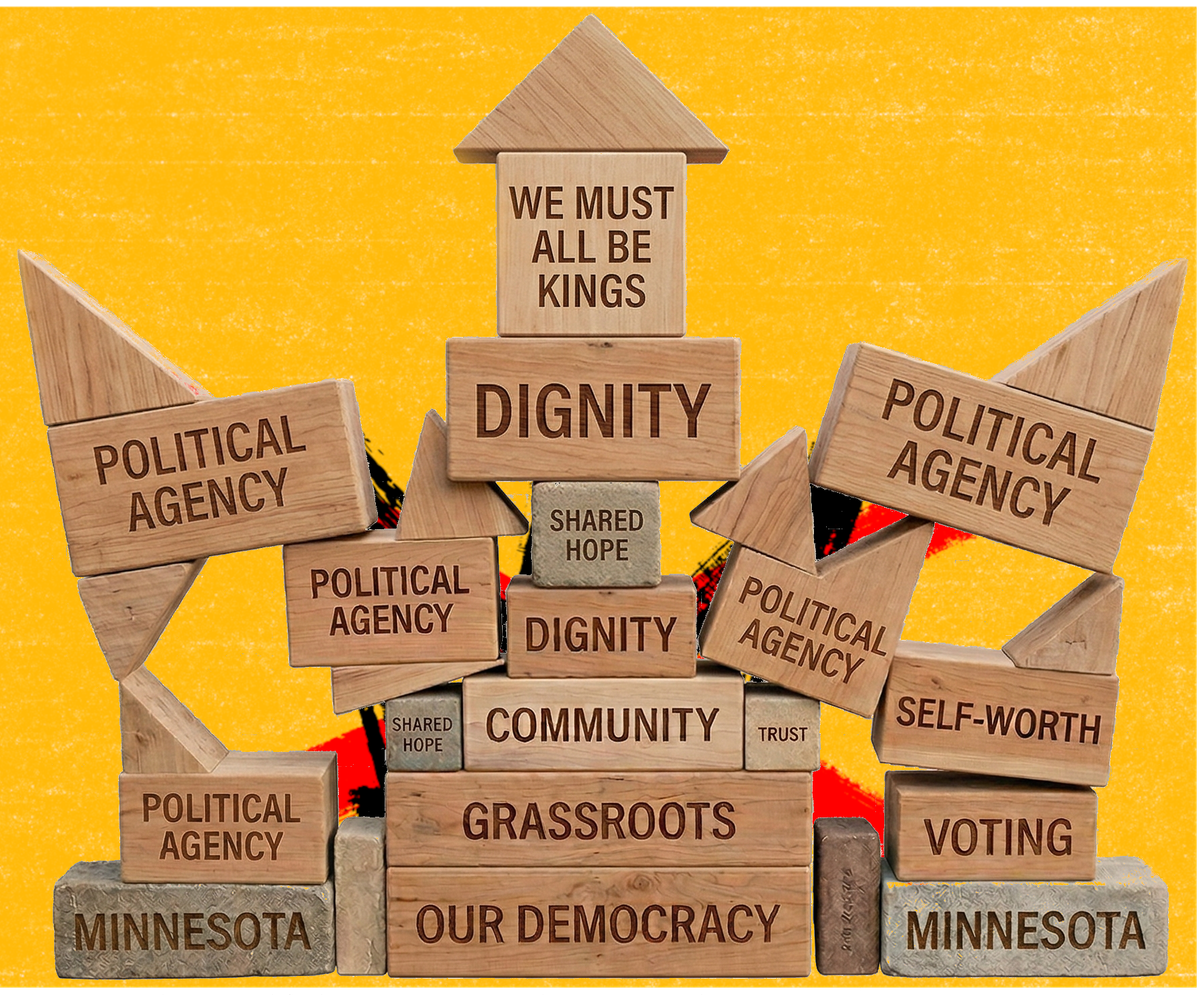
We need a social movement to recapture our political self-worth, a revival of democracy, not by elections, but in ourselves.
By 2016, the regard people held for their vote was so denigrated that casting a ballot for an obviously unpresidential Trump made sense because government will never do anything for me, so it will not do anything for you either. The pandemic drove Trump from office but ironically protected him from his own economic incompetence, preserving his viability for the next election. Then the young Manosphere came to his rescue in 2024 because voting was not much more than a prank for them.
We must all be Sovereigns
I have worked in politics for over 30 years and have watched these changes from my electoral vantage point. We do need to win the House as a step to taking the Senate and the Presidency. The way to fight our political fatalism in the near-term is to gain majorities and then pass meaningful legislation quickly, such as restoring Obamacare subsidies, that clearly change lives for the better.
What concerns me most about No Kings is the challenge that lies beyond campaign cycles and elected office — in a place protests cannot reach. We, as a nation, have been conditioned to believe that collective action through government will always fail, that our fellow Americans are morally suspect, and that voting has no power to shape our common future. We may win a turnout war for one election, but this pressure is always there, waiting to stifle any lasting change at its start.
So on No Kings Day eve, consider how we got here and what must be changed to protect our democracy. While No Kings focuses on Trump and avoids a broader MAGA indictment, we must still ask — can we blame those responding to what has been done to them by the powerful? What hope will survive for long with a good congress and a new president, even with successes, if everything else about our political culture remains conditioned to seek failure?
We do need a social movement to recapture our political self-worth, a grand revival of democracy, not by elections, but within ourselves. Our future faces a greater challenge than defeating one man. Unless we all, as a nation, truly change how we see ourselves as political actors, governments at every level will subvert our pursuit of happiness and deliver us the next Trump — one who will have learned from past mistakes. We must all be Kings, sovereigns with political agency and worth, or abdicate and lose democracy for all.
Comments ()