
A Day in the Life of Epstein-with Andrew Update.
What did Jeffrey Epstein’s day actually look like? Using a random sample of the DOJ email release, I estimate his outgoing email volume and show how a steady stream of short, operational messages helped administer a trafficking enterprise. UPDATE: Andrew arrested--what did our emails have.
A random sample of evil says much
The Epstein files were released, and everywhere people combed the records to find evils done by men. My question about this data is different. Between all his "massages" and human trafficking, how did Epstein have time to write all these emails? What did his day look like?
From what I can see in the data, Epstein was certainly much more predator and pimp than any billionaire investor. His day does not line up any other way—and the data shows what it took for him to run his human trafficking empire. I know a statistical analysis could never bring victims any justice. My aim is different--to see how Epstein managed this evil to make such an abomination a reality.
Datasets
Data Set 9 in the Department of Justice (DOJ) release has a bulk of the emails, coming in at 1.2 million pages, so that is where I drew a random sample. I used Claude.Ai to extract, clean, and classify roughly 2,000 Epstein emails from a random sample of 3,000 DOJ files, spot-checking outliers and edge cases along the way. For you number geeks, the sampling process reveals the dataset contents.
| Metric | Sample | Full data set* |
|---|---|---|
| Discrete documents (files) | 3,000 | ~460,000 |
| Email messages | 5,900 | ~905,000 |
| Epstein-authored emails | 1,952 | ~300,000 |
How Many Emails?
Now, there is a caveat on this dataset—collected for investigation, it likely skews towards those aims. That said, I checked the House Oversight database, a less goal-oriented Epstein email collection, and the following math holds up.
First thing I did was just work from the sample and estimate how many emails Epstein wrote per day, from 2009 to early 2019, when his email activity effectively ended. He sent only a handful of messages from April 2019 through his arrest on July 6, 2019. All my numbers from here on out take my sample data and extrapolate it to the population of all the Epstein emails in Data Set 9.
| Dated messages in sample (2009–Q1 2019) | 1,908 |
| Calendar days | 3,742 |
| Emails sent per day* | 79 |
| Typical length† | 3 words |
| Median email length | 7 words |
| Average email length | 13 words |
This is not an unusual number of emails, compared to research from the day which would estimate 40–80 sent emails per day from an executive. The Radicati Group's annual surveys found the average business user sent 30–40 emails per day during the 2011–2019 period, with heavy users in the top quartile sending 50 or more. A Harvard Business School study of 27 CEOs found they spent 24% of their work week on email—roughly three hours a day. Epstein was on the high side, but not an outlier.
Published benchmarks from the period suggest executive emails averaged 24–36 words with optimal response length at 50–125 words. Epstein's median of 7 is dramatically shorter. The only comparable figure in the popular record is Jeff Bezos and his famous single-character "?" forwards to Amazon executives, which became a management case study.
What Length Says
| Percentile | Words or fewer |
|---|---|
| 10th | 1 |
| 20th | 2 |
| 30th | 3 |
| 40th | 5 |
| 50th (median) | 7 |
| 60th | 9 |
| 70th | 12 |
| 80th | 17 |
| 90th | 27 |
| Max | 469 |
340 of 1,952 messages (17.4%) are one word or fewer—"ok," "yes," "no," or a forwarded blank.
Some will say who cares how short Epstein's emails were, he was a bro with a BlackBerry being a jerk. Others say every pretentious executive probably sent 20% one word or less emails. Whatever the baseline, how his emails vary in length depending on the topic says a great deal.
| Category | Messages | % | Per day* | Typical† |
|---|---|---|---|---|
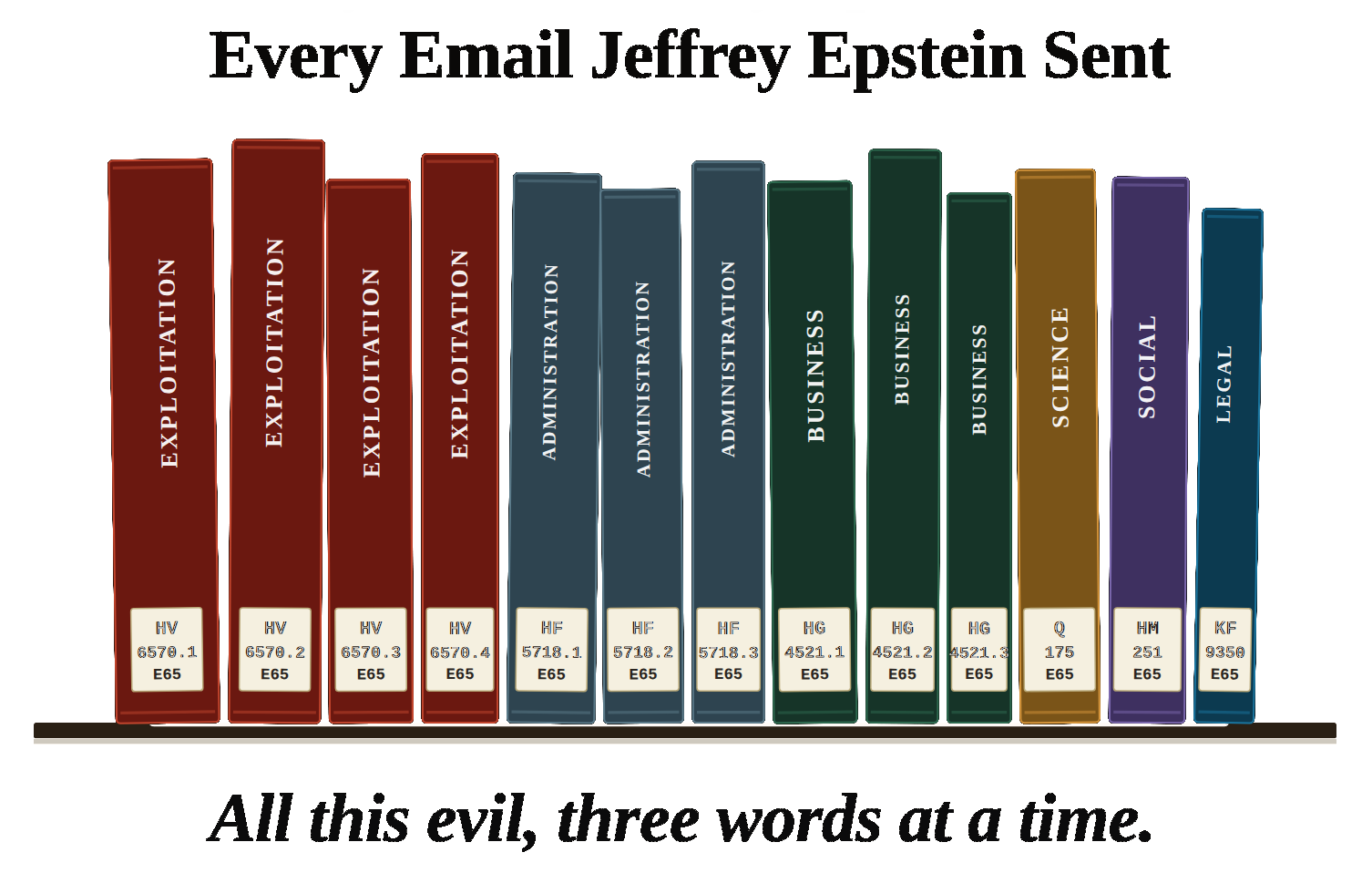
| Administration | 811 | 41.5% | 33 | 3 words |
| Exploitation | 594 | 30.4% | 24 | 4 words |
| Business | 237 | 12.1% | 10 | 4 words |
| Social | 145 | 7.4% | 6 | 4 words |
| Science | 108 | 5.5% | 5 | 5 words |
| Legal/PR | 57 | 2.9% | 2 | 3 words |
| Total | 1,952 | 100% | 79 | 3 words |
You can see what mattered to Epstein. I parsed his emails based on content, participants, threads and redactions to assign broad categories. The next data caveat is that nearly half (47.4%) of Epstein's outgoing emails have fully redacted headers, leaving the recipient completely unidentified. We cannot use names to better categorize these emails. However, most of what I will talk about does not need names, just text, and redactions themselves are telling.
Administration is a broad category that runs from arranging trips to purchasing furniture, car repair to home stereo system installs. It is dominated by emails with Lesley Groff, his executive assistant; Richard Kahn, his accountant; and Larry Visoski, his pilot. Ghislaine Maxwell is obviously missing, except for the few emails DOJ missed because they forgot she used GMax as a screen name until 2011.
Business is everything that you would think a high-achieving billionaire would write about. Anything touching on funds, contracts, deals and the like, those went into this bucket. Epstein had no company domain email and already averaged at 79 emails a day on this Gmail account, so this category likely represents his business activity on email.
Social is a catch-all of emails with people who, at least for the email, were not connected to other categories. This is the "meet you at 4" kind of coordinating and chatting with friends or family unconnected to his criminality. Social is the only category that changed over a week, with these messages clustering around the weekend. The other categories were seven-days-a-week affairs.
Legal and PR covers some lawyer emails and one discussion on how to buy Google keywords to hamstring searches on his name. This bucket also includes a few reporters as well, notably Michael Wolff. This is the smallest, and could go into Administration, but it is different and does not fit anywhere better.
Science contains emails to scientists and researchers—from extended exchanges with Noam Chomsky to arrangements for food at a TED event. Some are grant-seeking and academic logistics; others are attempts at connecting as an intellectual peer.
Lastly, there is Exploitation. This was difficult to corral, because few messages have specific details. There is grooming, maintaining, logistics, procuring and massages, but much is between the lines. These emails range from "doesn't look right" to "call 911." Any message with 'girl' was immediately suspect, along with mentions of nationality. Redactions were also telling. But there are more subtle things like a mention from a redacted person about going to Ohio. Parts of this were very subjective and people could surely argue about coding, but this is a solid representation of what was in those emails.
Another way of visualizing what occupied Epstein's time was to compare by category the number of messages sent to the total words he actually wrote. Just to give a sense of scale.
| Category | % of messages | % of words |
|---|---|---|
| Administration | 41.5% | 24.4% |
| Exploitation | 30.4% | 34.5% |
| Business | 12.1% | 20.8% |
| Social | 7.4% | 8.5% |
| Science | 5.5% | 9.4% |
| Legal/PR | 2.9% | 2.4% |
While he sent more Administration messages, from a taking-time-to-write perspective, Exploitation is foremost in Epstein's emails. occupying nearly a third of his email output.
VIP Treatment
You can see what Epstein cares about, in frequency and in length. Another finding is his word length does not vary much at all by VIP status.
| Who | Messages | Median | Typical† |
|---|---|---|---|
| Noam Chomsky | 23 | 22 | 5 |
| Jes Staley | 14 | 11 | 4 |
| Steve Bannon | 11 | 4 | 4 |
| Ehud Barak | 8 | 4 | 2 |
| Peter Thiel | 7 | 23 | 8 |
| Bill Gates | 4 | 117 | 4 |
| Larry Summers | 4 | 26 | 9 |
Look at the typical length column. A former Israeli Prime Minister gets 2 words. The man who helped elect a president gets 4. Bill Gates gets 4. The only correspondent who consistently draws Epstein past his usual terseness is Peter Thiel, at 8—and even that is one short sentence. The medians tell a slightly different story: Epstein wrote longer individual emails to Thiel (23 words), Summers (26), and Chomsky (22), but his typical effort was the same for almost everyone. Gates's median of 117 is an artifact of four messages in a single long thread—his typical email still lands at 4 words.
I began to wonder just how smart Epstein was with all this monosyllabism, but when he decided to write, he kept up with his correspondents. Take Chomsky for example. In one thread, Chomsky writes about whether memory constitutes a distinct biological module. Epstein responds with 225 words—his longest email to Chomsky—proposing that human memory is a biological object, arguing about how the mapping of light "filters it, focuses it, maps onto mental constructs" and connecting it to Gromov's mathematical language for expressing scientific ideas. Chomsky responds substantively. Then Epstein files away a Gromov quote for later. This is the only context in the data where Epstein attempts to sound like a peer.
The Banality of Epstein
It is worth noting how much more people talking with Epstein wrote than he ever did in return.
| Category | Epstein† | Correspondent† | Ratio |
|---|---|---|---|
| Administration | 3 | 6 | 2.4× |
| Exploitation | 4 | 8 | 2.0× |
| Business | 4 | 8 | 2.0× |
| Science | 5 | 11 | 2.3× |
| Social | 4 | 7 | 1.6× |
| Legal/PR | 3 | 5 | 1.5× |
Clearly he did not need to cozy up to most people in his universe. People opened up about what they wanted to Epstein, and he, through his short emails, merely nodded as they spoke.
Epstein did so much damage with so very few words. When you look at the Exploitation category, messages cleave into two clusters. One was his immediate "needs" and the other focuses on maintaining his roster and connecting men to it.
Higher threat | Lower threat | |
|---|---|---|
| What's in here | Procurement, control, massage scheduling, explicit grooming | Logistics, intermediaries, coded scheduling, infrastructure |
| Messages in sample | 111 | 483 |
| In full data set* | ~17,000 | ~74,000 |
| Per day* | 9 | 39 |
| Epstein typical length† | 5 words | 4 words |
| Correspondent typical length† | 17 words | 7 words |
| They write X times more | 3.6× | 1.9× |
Here you can really see what mattered to him. The everyday logistics of his pimping and ruining lives took fewer words, while his personal interest in girls or massage parlors made him more engaged. But nowhere is a mustache-twirling exposition found in his writing. Just scant words, dispatching women and girls here and there, a few lines to groom or retain them, quick notes answering what men were looking for and arranging for his massages. That is it.
There is little evidence Epstein was an investment genius who ran his island human trafficking enterprise as a passion project hobby. Not with only 13% of his emails even touching on business. No, pimping was his job, raping was his passion and, somehow, he came across substantial resources to travel the world to make his island and perversions possible.
Statistical Meaning
Today, people hunt for the guilty in Epstein's emails--as should be done. These individual emails though do not give an accurate picture of how Epstein built and maintained his criminal enterprise. It was his 28,700 per year, 2,400 per month, 79 per day emails averaging 3 words each that brought such evil into the world.
It was mostly composed of emails to pilots, accountants, and assistants; missives to contractors and interior decorators; schedules for travel, meetings, and public events; and cryptic short messages that moved people around the globe for exploitation.
This piece cannot console any victims nor provide insight into Epstein's psyche. Its aim is to provide a scale to describe events and shows that evil is not complicated, but it is persistent. Somewhere today in this world, the next Epstein is grinding out text messages and Signal chats to build a new illusion and bring a new island into our world. I simply hope more of us will learn how to see through these deceits and end such projects before they ever go this far again.
Andrew Update:
Andrew Mountbatten-Windsor was arrested February 19 on suspicion of sharing confidential trade envoy reports with Epstein. Four emails across three threads in our sample, all falling within his 2001–2011 tenure as UK Special Representative for International Trade and Investment. In September 2009, Andrew requests use of Epstein's Paris apartment for a private weekend — apartment, car, and driver included. No payment discussed. In November 2010, Epstein instructs Andrew to broker an introduction to Sheikh Hamad of Qatar, supplying two social pretexts to make the ask feel casual. Andrew reports back that Hamad had already departed, but that the message was passed to an alternate channel.
By 2016, Epstein has Hamad's direct number and is speaking with him by phone on the day of the Brexit vote. By 2018, an intermediary is writing to Epstein on Hamad's behalf about crude oil positions the Qataris are managing. Andrew tried to open that door in 2010 using official trade channels. Whether he succeeded or not, the door was open by the middle of the decade.
In March 2011 — the final months of Andrew's trade envoy appointment — a correspondent writes to brief Epstein on how Andrew's inner circle is framing their association. The characterization they had settled on: "unwise." That is the word someone close to Andrew chose. The arrest allegation is consistent with every Andrew thread in our small 3000 email sample. What else is out there?
France Update:
This week Paris prosecutors opened two investigations — one into sex crimes, one into financial wrongdoing — and called on victims to come forward. Just over 5% of Epstein-authored emails in our sample touch on France — distributed continuously from 2010 through 2019. EXPLOITATION-coded messages run 10% points above Epstein's average in this French cluster. France was not peripheral to Epstein's operations. It appears to be integral.
Every name now under investigation appears in our sample. Jean-Luc Brunel, 38 messages, every Epstein-authored one coded EXPLOITATION. Jack and Caroline Lang, 18 messages — Epstein pursuing a fund contingent on the elder Lang's agreement. Diplomat Fabrice Aidan, forwarding political intelligence into a thread shared with Epstein and Ariane de Rothschild simultaneously. Model recruiter Daniel Siad, whom Epstein chided for not having "showed me anyone" recently. Prosecutors describe their work as "titanic." In our sample 39.4% of France-touching emails are coded EXPLOITATION, versus 29.9% overall. This French Epstein connection in our data appears to highlight the relationships now under investigation in France.
Afterwards
I know enough about statistics to get into trouble, but not necessarily enough to get out of it. This was a very basic look at data with a very rusty statistical brain new to AI data processing. With that said, I gathered a solid random sample, realized the data's limits and used simple descriptive statistics to make my point. Coding may be argued, but I believe my choices are reality-based, and that reasonable alternative coding would still show the magnitude and directions found in this analysis. I am happy to share specifics to those who ask.
Notes
* Population estimates and daily rates are midpoints of 95% confidence intervals. The full range is typically ±5% of the figure shown. For example, "79 per day" is the midpoint of 76–81.
† "Typical length" is the harmonic mean—a kind of average that resists being pulled upward by a few long emails. When someone mostly sends 2-word and 5-word messages but occasionally writes 200 words, the regular average says 25 words. Typical length says 3. It better captures what the inbox actually felt like.
‡ Why not just use the median? The median (7 words overall) tells you the middle message. Typical length (3 words) tells you the middle effort—the length you'd guess if you picked a random email. Both are reported where they diverge meaningfully.


Comments ()